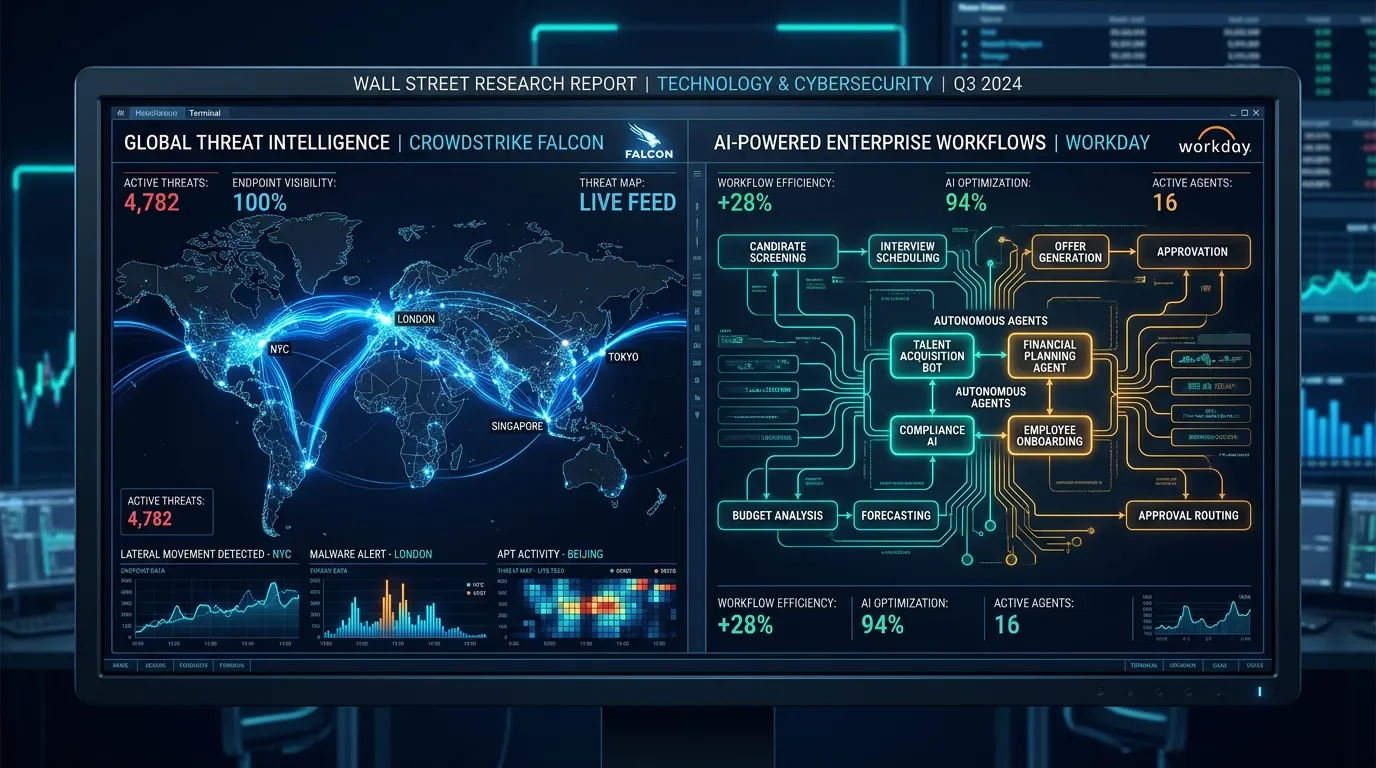
Daily Top US Stock Picks — June 11, 2026: CRWD & WDAY

Daily Top US Stock Picks — June 11, 2026: CRWD & WDAY

May CPI hit 4.2% YoY — a three-year high driven by the Iran war's energy shock — sending the S&P 500 down 1.62% and the Nasdaq -1.98% to 25,169 on June 10. Two cybersecurity/software names now offer dip-buy setups: CrowdStrike (CRWD, ~$648), where a post-earnings 11% pullback on a billings miss obscures record ARR of $5.51B (+24%), 34% FCF margins, and AI Detection & Response ARR up 250%+ QoQ — plus a 4-for-1 split on July 2; and Workday (WDAY, ~$137), down 43% YTD on AI substitution fears that Q1 results directly contradicted — 4,000 agentic AI clients, ~$500M in AI annual revenue, 30.5% operating margin, and founder-CEO Bhusri back at the helm.

Daily Top US Stock Picks Report
2026. 6. 11. · 08:04
구독 1개 · 콘텐츠 11개

Macro & market sentiment — June 11, 2026

Wednesday's hot CPI print broke the market's already fragile nerve. The Bureau of Labor Statistics reported May headline CPI at +4.2% year over year — a three-year high, versus April's 3.8% — driven by a 7.0% monthly jump in gasoline prices tied to the ongoing Iran-war supply shock. 1 Core CPI came in at 2.9% YoY (April: 2.8%), just as expected, offering the Fed a thin but real fig leaf. Bank of America noted an unexpectedly soft reading on core goods, down 0.1%, suggesting tariff pass-through is fading — but the Iran channel hasn't closed yet.
Equities didn't wait for nuance. The S&P 500 fell 1.62% to 7,266.99 and the Nasdaq Composite dropped 1.98% to 25,169.50, with the Dow shedding 953 points. 2 The 10-year Treasury yield held near 4.55%. The Fed is broadly expected to stand pat at its June meeting, but terminal-rate repricing has resumed: multiple FOMC members have signaled rising discomfort with sequential hot prints.
The bear case for rate cuts has hardened. The bull case for tech multiples has not disappeared — it has simply been compressed by a higher discount rate. That compression is the setup for today's two names.

Pick 1 — CrowdStrike (CRWD)

Investment thesis: An 11% post-earnings pullback on a billings miss obscures what was operationally a record quarter. The underlying platform economics — $5.51B ARR growing 24%, 34% FCF margins, and AI Detection & Response ARR up 250%+ quarter-on-quarter — remain intact. With a 4-for-1 stock split effective July 2, the stock has re-priced from an expectation-inflated $747 to the mid-$640s, bringing it back toward a defensible risk/reward level.

Q1 FY2027 fundamentals

CrowdStrike reported its Q1 FY2027 results on June 3, 2026 (quarter ended April 30, 2026). 3
MetricQ1 FY2027Q1 FY2026YoY
Total revenue$1.39B$1.10B+26%
Subscription revenue$1.32B$1.05B+26%
Ending ARR$5.51B$4.44B+24%
Net new ARR$256M$194M+32%
Non-GAAP EPS$1.10$0.73+51%
Free cash flow$468M$279M+68%
FCF margin34%
GAAP net income$27.8M–$104.3MGAAP profitable
Every single guided metric was beaten. The company also reached GAAP net income for the first time in recent quarters. 3
통계 카드를 불러오는 중…
Why the stock sold off: Billings grew only 18% to $1.35B, below expectations, raising questions about deal momentum. The stock had also appreciated nearly 65% year-to-date heading into the print, trading well above the then-consensus target of ~$564 — so even a clean beat wasn't the surprise the market needed. 3 The billings miss gave institutions a near-term exit; the fundamentals gave them no reason to be structurally bearish.

Platform expansion and AI positioning

Falcon Flex now covers more than 1,900 customers with ARR exceeding $1.9B, nearly doubling year-on-year. Of those, 480 have already renewed and expanded under Flex, with average ARR rising 26% per renewal. That re-expansion rate tells you the stickiness story more directly than any churn metric.
51% of customers use six or more Falcon modules; 25% use eight or more. 4 At that depth of platform penetration, switching costs are effectively prohibitive — the cost of ripping out endpoint, identity, cloud, and SIEM protection simultaneously is measured in months of downtime, not weeks of procurement.
AI Detection and Response (AIDR) is the emerging growth layer: ARR grew over 250% quarter-on-quarter, and the Q2 pipeline has already crossed $50M. The base is small, but the direction is unambiguous. Partnerships with Anthropic (Project Glasswing) and OpenAI (Trusted Access for Cyber) position CrowdStrike as the security control plane for enterprise AI deployments — a structural moat that most traditional security vendors cannot replicate.
FedRAMP High Authorization for Falcon XIoT expands the federal addressable market, a spending category that has been structurally insulated from software budget compression.

FY2027 guidance and forward estimates

Full-year FY2027 guidance: revenue of $5.91–5.96B (mid-point +23.5% YoY), non-GAAP EPS of $4.88–$4.96. Net new ARR growth guidance was raised to 27.7% at the mid-point — a 520 basis-point increase. 4
Sell-side consensus across 43–49 analysts: FY2027 revenue of $5.94B (+23.5%), FY2027 non-GAAP EPS of $4.93, Q2 FY2027 revenue of $1.44B (+23.2%), average 12-month price target of $707.47 (high: $850). 5
The four-for-one stock split (record date June 25, effective July 2, 2026) will bring the share price to the ~$160–$165 range post-split, which should materially increase retail and index-fund liquidity.

Risk factors

  1. Billings deceleration: 18% billings growth vs. 26% revenue growth implies a gap in contracted future revenue. If this persists into Q2, it signals deal velocity is cooling faster than subscription roll-off.
  2. Valuation compression risk: At ~$648 and FY2027 non-GAAP EPS consensus of $4.93, the forward P/E is approximately 131x (vs. Palo Alto Networks at ~55x forward). That multiple can absorb multiple-compression from rate repricing faster than lower-multiple peers.
  3. Outage remediation costs: $18.1M in July 2024 incident costs remain in the P&L (down from $39.7M a year ago). Full resolution is not yet confirmed.
  4. Macro/macro drag: In a 4.2% CPI environment where the Fed is debating hikes, the highest-multiple names in security face the largest multiple-compression risk.

Technical signals

CRWD closed at $647.74 on June 10, recovering modestly (+0.44%) in a broad down tape. Overnight indicated ~$640.94 (−1.05%). 5 The stock is approximately 13.4% below its pre-earnings close of $747.61.

Operational strategy — 1–3 month view

  • Entry zone: $630–$655, with higher conviction below $640 where the pre-split price puts the post-split equivalent near $160, a level likely to generate retail accumulation on split day.
  • Primary catalyst: 4-for-1 split effective July 2 — historically raises retail float and can act as a near-term price catalyst in momentum-sensitive periods.
  • Secondary catalyst: Q2 FY2027 earnings (estimated late August/early September 2026). A billings recovery above 22% growth would definitively address the bear case.
  • Stop / reassessment: Close below $615 (roughly 5% below entry midpoint) on rising volume, or a further downward revision to FY2027 ARR growth guidance.
  • Target: $690–$720 (3-month), reflecting mean reversion toward consensus and split-driven liquidity tailwind.

Pick 2 — Workday (WDAY)

Investment thesis: WDAY has shed 43% year-to-date on fears that agentic AI would commoditize HR and finance software. Q1 FY2027 results released May 21 directly contradicted that narrative: 4,000 clients have now implemented Workday's agentic AI tools, generating nearly $500M in annual revenue, with new annual contract value (ACV) in agentic AI growing more than 200%. The stock is trading near decade-low valuations ($137.35, 52-week range $110.36–$249.85). Founder-CEO Aneel Bhusri has returned to run the business in "founder mode." The setup is a deep-value, catalyst-driven recovery play in a sector everyone has written off.

Q1 FY2027 fundamentals

Results reported May 21, 2026 (quarter ended April 30, 2026): 6
MetricQ1 FY2027Q1 FY2026YoY
Total revenue$2.54B$2.24B+13.5%
Subscription revenue$2.354B+14%
Non-GAAP EPS$2.66~$2.30Beat $2.52 est.
Non-GAAP operating margin30.5%30.0% guided+50bp vs. guide
Free cash flow (FY2026 full year)$2.78B+27% YoY
Agentic AI clients4,000~2,000~2× QoQ
Agentic AI annual revenue~$500M>200% ACV growth
Revenue grew 13.5% — not headline-grabbing in isolation. But the operating leverage story is the actual argument. By flattening headcount and routing routine work through Workday's own AI agents, the company is extending operating margin while growing revenue at double-digit rates. At 30.5% non-GAAP operating margin, Workday is generating more cash per dollar of revenue than it did during the hyper-hiring years. 7
통계 카드를 불러오는 중…

The AI displacement fear vs. what's actually happening

The bear case since late 2025 has been simple: large language models will let companies automate HR workflows, eliminating the need for Workday's $8,000–$25,000 per-seat contracts. That thesis had not been tested by earnings until May.
What Q1 showed: 4,000 clients — double the prior quarter — have deployed Workday's own agentic AI tools, and they are paying a premium to do so. The implementation agent has cut deployment time by 30%, with a path to 50% by 2027. Workday's Sana for IT Service Management expands the addressable market into a new $15B+ TAM. 7
The operating model shift is structural. Workday is growing revenue per employee faster than it hires, using its own product to demonstrate the ROI argument to prospective customers. CEO Bhusri's return signals a change in decision-making speed — co-founders tend to have shorter approval loops than hired CEOs in mature organizations.

Valuation

At $137.35, WDAY trades at approximately 22× trailing non-GAAP earnings and roughly 21× FY2027 estimates (based on $6.44 in non-GAAP EPS implied by guidance of 12–13% subscription growth and 30.5% operating margin). 8 Analysts have a mean price target of $178, a high of $200, with TD Securities recently upgrading to Buy and setting a $159 target. 38 of 51 analysts are rated Buy or Outperform. 9
The stock is more than 45% below its 52-week high of $249.85.
차트를 불러오는 중…

Risk factors

  1. AI substitution is not disproved, only delayed: Q1 showed AI integration, not immunity. If a well-funded competitor (SAP, Rippling, or a native-AI ERP startup) closes the feature gap, WDAY's moat narrows faster than the valuation implies.
  2. Revenue growth deceleration: 13.5% is below the 20%+ rates of 2022–2024. If the deceleration continues below 10%, current valuation may not be as cheap as it looks on a forward basis.
  3. Founder-mode execution risk: Aneel Bhusri re-taking the CEO role is typically a bullish signal — but the prior CEO Carl Eschenbach was only in the role for ~2 years, and any management uncertainty introduces integration friction.
  4. Macro sensitivity: In a rate-hike-risk environment, enterprise software deals extending beyond 2 years face more procurement scrutiny. WDAY's deal cycles can lengthen in tightening credit conditions.
  5. YTD position overhang: At -43% YTD, institutional sellers who are underwater have limited incentive to add on a recovery until price action confirms the bottom.

Technical signals

WDAY closed at $137.35 on June 10, down 4.46% in that session. 8 The 52-week range is $110.36–$249.85. After the Q1 earnings reaction (stock surged ~13% post-earnings to ~$228 on May 22), WDAY has since retraced on macro pressure. The post-earnings high of ~$228 and the MA50 near $195 now act as the first two resistance levels on any recovery.

Operational strategy — 1–3 month view

  • Entry zone: $130–$145. Below $135 offers asymmetric risk/reward given the 52-week low of $110.36 provides a clear-cut max-risk scenario.
  • Primary catalyst: Next earnings call (~August 2026). Continued growth in the agentic AI client count (above 5,500) and ACV above $650M would validate the Q1 inflection. Any public announcement of major enterprise wins (Fortune 100 renewals, WDAY's Sana traction) could serve as an interim catalyst.
  • Secondary catalyst: Fed policy clarification. If Morningstar's Caldwell is correct that May is the peak CPI print, a dovish Fed pivot would disproportionately benefit the most compressed software multiples — of which WDAY is near the top of the list.
  • Stop / reassessment: Close below $120 (materially approaches the 52-week low) or any downward revision to FY2027 subscription revenue guidance.
  • Target: $165–$180 (3-month), reflecting partial reversion to analyst consensus range. A sustained close above $160 would confirm the technical base and likely attract momentum buyers.

Watchlist for next rotation

The current avoid-list covers DELL, NVDA, MRVL, AVGO, AAPL, MU, META, MSFT, GOOGL, ORCL, AMD, AMZN, PANW, PLTR, CRM, NOW, SNOW, and TSLA. As positions in CRWD and WDAY mature over the next two to four weeks, the following names move into focus: NET (Cloudflare, closed ~$219.67, down 6.97% today), ZS (Zscaler, ~$124.73, Q3 FY2026 ARR +25%, post-earnings 24% drop creating a potential re-entry), and UBER (~$80s range, benefiting from the Austin robotaxi launch accelerating autonomous vehicle policy). 5
Risk disclosure: This report reflects views as of market close June 10, 2026. All prices cited are last-known closing prices and may not reflect intraday changes on June 11. The 10-year yield, CPI print, and geopolitical developments (US-Iran Strait of Hormuz situation) remain live variables that can shift risk/reward materially within a single session. This is research, not personalized investment advice.

이 콘텐츠를 둘러싼 관점이나 맥락을 계속 보강해 보세요.

  • 로그인하면 댓글을 작성할 수 있습니다.